
Lyo-Ready Direct RNA NASBA Blood
RT-qPCR became the standard for RNA detection because of widely available reagents and standardized workflows. Now you can unlock the advantages of isothermal RNA amplification without the complexity of developing Nucleic Acid Sequence-Based Amplification (NASBA) formulations in-house. Lyo-Ready Direct RNA NASBA Blood is a glycerol-free, lyophilization-ready NASBA mix designed for sensitive one-step RNA amplification directly from whole blood, plasma and serum at 41 °C, eliminating the need for thermal cycling or thermal denaturation. Lyo-Ready Direct RNA NASBA Saliva can be used wet or lyophilized, enabling transition from liquid assay development to ambient-stable point-of-care formats without reformulating.
Have questions about a product?
Key Product Features
-
Streamline Workflow: A one-step, single-tube solution combines all components into a pre-prepared mix, operating efficiently at 41 °C.
-
Improved Usability: Reduces hands-on time by up to 50%, boosting workflow efficiency.
-
Rapid Results: Delivers fast isothermal RNA amplification without thermal cycling.
-
Optimized for Point-of-Care (POC) Diagnostics: Ideal for integration into low-cost, portable diagnostic devices for POC use.
Specificity in whole blood, plasma and serum
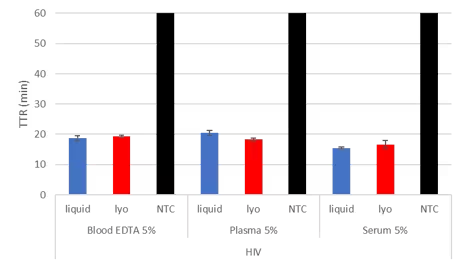
Lyo-Ready Direct RNA NASBA Blood (MDX220) was examined using HIV RNA in 5% human whole blood EDTA, plasma and serum in both liquid (blue) and lyophilized formats (red). Reactions were incubated at 41°C for 60 minutes. Error bars represent the standard deviation across three technical replicates. Lyo-Ready Direct RNA NASBA Blood provides fast results, high-specificity and reproducibility to give the same accurate results from blood derivative samples in both liquid and lyophilized formats.
Description
Lyo-Ready Direct RNA NASBA Blood (MDX220) is a glycerol-free, lyophilization-ready master mix developed for rapid RNA detection from whole blood, plasma and serum using NASBA. In contrast to conventional NASBA protocols, which require a pre-denaturation step at 65 °C to prepare RNA and primers, Lyo-Ready Direct RNA NASBA Blood streamlines the process into a single-pot, one-step NASBA procedure without the need for thermal denaturation. Additionally, its glycerol-free, lyo-excipient-enhanced formulation supports freeze-drying, simplifying the development of ambient-temperature stable assays that are particularly well-suited for point-of-care (POC) whole blood, serum and plasma testing.
This formulation is designed to address key challenges in blood-based molecular diagnostics. While blood is commonly processed using lab-based qPCR methods, the growing demand for accessible diagnostics has driven the rise of point-of-care (POC) testing. This approach is particularly beneficial for RNA analysis, as delays between sample collection and testing can compromise RNA integrity, adversely affecting assay reliability and performance.
Lyo-Ready Direct RNA NASBA Blood is designed for sensitive RNA detection in minimally processed whole blood, plasma, or serum. It tolerates inhibitors, delivers rapid results at low temperatures, and includes lyo-excipients for ambient-temperature stable assays. These features make it ideal for point-of-care blood testing with high sensitivity and operational simplicity.
Key Points
- High Sensitivity: Detects RNA from both minimally processed and purified whole blood, plasma and serum samples
- Simplified workflow: One-step process requiring only the addition of primers and molecular beacons, eliminating the need for a denaturation step
- Reduced Assay Development Time: Pre-optimized master mix for rapid deployment.
- Point-of-Care Ready: Lyo-ready for ambient-temperature stable assays, eliminating cold-chain dependence.
Lyo-Ready Direct RNA NASBA Blood, MDX220
Single pot, one-step Nucleic Acid Sequence-Based Amplification (NASBA) for reliable isothermal amplification of RNA transcripts from crude or purified blood samples, ideal for POC testing
Available in 50 reaction (400 µL) and 250 (2 mL) reaction aliquots
Catalogs & Brochures
Catalog
FAQs: Lyo-Ready Direct RNA NASBA Blood
What enzymes are used in the NASBA mix?
Three enzymes are used in the NASBA mix: reverse transcriptase, RNase H and RNA polymerase. The RT enzyme synthesizes the complementary DNA strand of a given RNA using one of the primers included in the reaction. RNase H removes the RNA template from RNA-DNA hybrid to allow binding of the second primer to cDNA, producing double-stranded DNA by RT enzyme. Afterward, the polymerase transcribes the double-stranded DNA to copy the RNA target.
What are the advantages of NASBA over traditional PCR?
NASBA is isothermal (amplification of the RNA is usually carried out at 41°C), so it does not require thermal cycling, which simplifies the equipment and reduces the risk of temperature-related errors. It is specifically designed for RNA targets, making it highly suitable for detecting RNA viruses and mRNA. NASBA amplifies RNA rapidly with high sensitivity, making it useful for applications requiring quick results.
What are the limitations of NASBA?
The requirement for multiple enzymes and specific reaction conditions can make NASBA more complex to set up compared to some other methods, to overcome these difficulties, and to make this technology more accessible, we developed the NASBA mixes, which are pre-optimized and ready-to-use The design of primers must also be highly specific to the target RNA to avoid non-specific amplification and one of the primers must include a T7 promoter sequence for RNA transcription by T7 RNA polymerase.
Can NASBA be used for DNA targets?
NASBA is primarily designed for RNA amplification. However, DNA targets can be indirectly detected if they are first transcribed into RNA using an additional transcription step.
What are the applications of NASBA?
NASBA has been used in medical diagnostics from blood, to detect RNA viruses such as HIV, hepatitis C, pathogens such as Plasmodium falciparum, Trypanosome sp., Leishmania and parasites such as Toxoplasma gondii.
Get in Touch with a Life Science Specialist
Have questions about a product? Want to learn more about Meridian’s molecular or immunoassay reagent portfolio? We want to hear from you!
By submitting your information in this form, you agree that your personal information may be stored and processed in any country where we have facilities or service providers, and by using our “Contact Us” page you agree to the transfer of information to countries outside of your country of residence, including to the United States, which may provide for different data protection rules than in your country. The information you submit will be governed by our Privacy Statement.