
From Sample to Sequence:
Why Smarter Library Prep is Critical for Whole Genome Sequencing
Whole genome sequencing (WGS) has become a cornerstone of modern genomics, with applications spanning oncology, infectious disease and rare inherited disorders. Beyond human health, it is equally valuable for sequencing agriculturally important species—including livestock, crops and disease-associated microbes. WGS provides complete genomic coverage, capturing both exonic (coding) and intronic (non-coding) regions, enabling the detection of single nucleotide variants (SNVs), insertions and deletions (indels), copy number variations (CNVs) and large structural rearrangements. This makes it particularly well-suited for discovery-driven applications such as novel variant identification and de novo genome assembly.
In the United States, WGS-based tests are not yet FDA-approved for routine clinical use, however, many laboratories have adopted them as laboratory developed tests (LDTs) under Clinical Laboratory Improvement Amendments (CLIA) oversight. In Europe, where companion diagnostics are not as tightly bound to drug approvals by the European Medicines Agency (EMA), there is greater flexibility in implementing genomic assays. This has enabled wider adoption of WGS-based LDTs in accredited laboratories, with validated pipelines supporting clinical decision-making.1
Despite its transformative potential and expanding clinical acceptance, the practical implementation of WGS still faces significant challenges. As sequencing costs decline and platform throughput increases, broader adoption is increasingly limited by a persistent bottleneck: library preparation.2 Traditional workflows are labor-intensive, reagent-heavy and often require skilled personnel to ensure consistency and data integrity. In response, next-generation library preparation methods have emerged, aiming to improve efficiency, scalability and reproducibility. Many of these workflows are now compatible with automation, minimizing manual handling and inter-sample variability—key advancements for scaling WGS in high-throughput research, clinical diagnostics and decentralized testing environments. In parallel, the use of lyophilized, glycerol-free reagents enables room-temperature shipping and storage, simplifies logistics and improves consistency by reducing freeze-thaw variability and supporting pre-plated, ready-to-use formats for automated systems.
Why Sample Preparation Matters
Sample types with limited input, compromised quality, or complex biological origins are now increasingly being addressed through the broader adoption of WGS. This presents a key challenge as sequencing performance is highly dependent on the integrity and consistency of the input-DNA. While qPCR and targeted panels may tolerate minor degradation or contaminants, they can critically impair WGS performance, resulting in uneven coverage, elevated duplicate rates and contamination artifacts. To ensure reliable results, the upstream preparation process must deliver clean, high-quality libraries that support accurate and reproducible sequencing across diverse applications.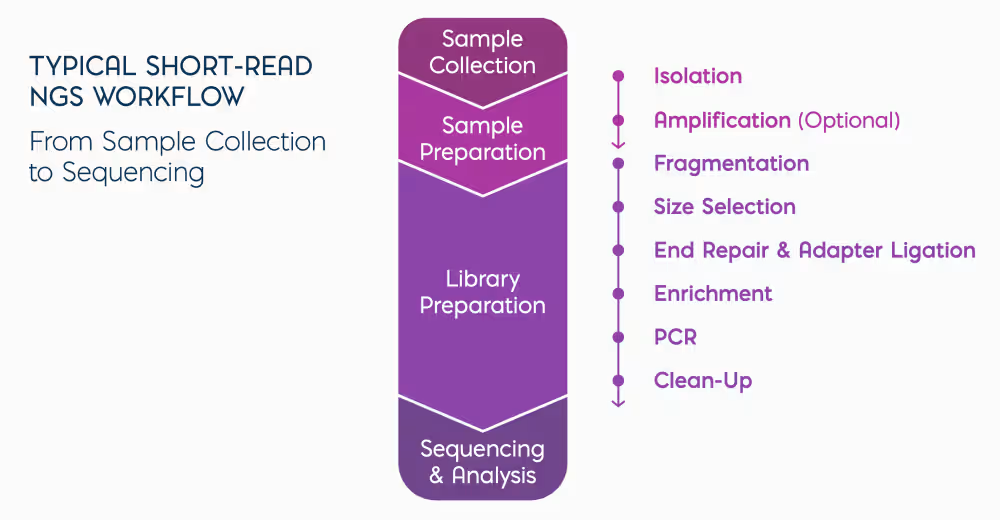
The Whole Genome Sequencing Workflow
In WGS, library preparation involves the critical process of converting extracted DNA into a format compatible with sequencing platforms. While every stage of the WGS workflow contributes to overall data quality, library preparation sits at the core, bridging sample integrity with sequencing performance. From nucleic acid extraction to final purification and quality control, each step must be carefully optimized to ensure accuracy, precision and completeness of genomic coverage. In the sections below, we outline the key stages of the WGS library prep workflow: Step 1: Nucleic Acid Extraction The WGS workflow begins with isolating high-quality DNA (or RNA) from biological samples such as blood, tissue, cultured cells, saliva or urine. The integrity and purity of this genetic material is critical, as contaminants, degradation or low yields at this stage can compromise every step that follows. As WGS is increasingly applied to more challenging specimens, effective extraction and upstream quality control become imperative to ensure reliable sequencing outcomes. Step 2: Library Preparation To be compatible with sequencing platforms, extracted nucleic acids must be converted into a sequencing-ready format. This process involves fragmenting the DNA to a defined size range and ligating adapters to the fragment ends. These adapters often contain unique barcodes (indexes) to enable multiplexing of multiple samples in a single sequencing run. Fragmentation can be performed using mechanical methods (e.g., sonication) or enzymatic approaches (e.g., fragmentase or transposase-based), each with distinct trade-offs in precision, bias and scalability. The efficiency and consistency of this step have a direct impact on library complexity, coverage uniformity and overall data quality. Step 3: Amplification (Optional) Depending on the input amount and application, PCR amplification may be used to increase library yield prior to sequencing. While PCR enables analysis of low-input samples, it can also introduce bias and duplicates if not properly controlled. For WGS, where coverage uniformity is critical, minimizing amplification bias is essential, especially when working with GC-rich regions or degraded templates. Step 4: Purification and Quality Control Library purification removes unwanted byproducts such as free adapters, enzymes or improperly sized fragments. Many sequencing platforms have optimal library size ranges, so size selection (typically bead-based or gel-based) is used to enrich appropriately sized fragments. Final quality control assesses library concentration and size distribution, often via fluorometry and capillary electrophoresis, to ensure samples meet input criteria for sequencing. Rigorous QC here prevents expensive sequencing failures and ensures confidence in downstream analyses. Together, these steps form an interconnected process with multiple critical control points where variability can arise and compromise downstream outcomes. For instance, DNA extraction methods influence yield and fragment length; an inconsistent shearing step can skew fragment sizes; suboptimal ligation can reduce library diversity and excessive PCR amplification can lead to high duplicate rates and coverage bias. Quality issues introduced early in the workflow will compound through subsequent steps—once sample integrity is compromised, even the most advanced sequencer cannot recover lost data quality.Advances in Library Preparation for WGS
Library preparation protocols for whole genome sequencing are inherently complex and the multistep design introduces multiple opportunities for sample loss, cross-contamination and operator-induced variability, especially in manual workflows. In addition, the cumulative use of high-cost reagents and extended hands-on time increases the operational burden and cost. Recent innovations in library preparation have aimed to address these challenges through multiple strategies: 1. Integrated Enzymatic Workflows Newer kits leverage enzymatic fragmentation combined with simultaneous end-repair and A-tailing, enabling DNA fragmentation and polishing to occur in a single reaction tube. This reduces hands-on time, minimizes DNA loss, and is more forgiving for fragmented or damaged templates (e.g., FFPE-derived DNA). Some platforms also include integrated damage repair enzymes to restore nicks or abasic (apurinic/apyrimidinic) sites prior to ligation – improving performance with compromised samples. 2. Lyophilized and Ambient-Stable Reagents Lyophilized formulations are increasingly adopted to improve reagent stability, consistency and ease of use. By removing glycerol and freeze-drying enzymes, these kits can be stored and shipped at ambient temperatures, eliminating cold chain requirements and reducing the risk of reagent degradation. This enhances reproducibility by avoiding freeze-thaw cycles, streamlines logistics, and enables broader deployment in decentralized or resource-limited settings. Additionally, lyophilized kits support pre-plated, single-use formats that are well-suited for automation and high-throughput workflows. 3. PCR-Free and Low-Bias Amplification Options PCR amplification, though often necessary for low-input samples, introduces GC bias and duplicates, which reduce library complexity and can skew variant allele frequencies. To minimize these effects, many workflows offer PCR-free protocols for high-input samples (≥500 ng), producing libraries with greater uniformity and more accurate representation of the genome. For applications requiring amplification, engineered high-fidelity polymerases are now available that tolerate high-GC content and reduce amplification bias. 4. Dual-Indexing and Unique Molecular Identifiers (UMIs) Modern library preparation kits often include dual index barcoding to mitigate index hopping, a known artifact in high throughput multiplexed sequencing. More advanced workflows incorporate unique molecular identifiers (UMIs) during adapter ligation. These short, random sequences uniquely tag each original DNA molecule, allowing downstream bioinformatics pipelines to distinguish true variants from PCR duplicates or sequencing errors. This enhances analytical accuracy in demanding applications such as somatic variant detection and liquid biopsy analysis. 5. Automation-Ready and Miniaturized Protocols Scalability is a growing concern as labs process more samples for large-scale studies or clinical WGS. Many library prep kits are now designed to be automation-friendly, with reduced pipetting steps, pre-aliquoted reagents and magnetic bead-based cleanup compatible with robotic systems. Protocols are also being miniaturized to work in reduced volumes (e.g., <10 µL reactions), which lowers reagent costs without sacrificing performance—especially beneficial in population genomics and high-throughput diagnostic workflows. By integrating smarter enzymology, stabilization technologies workflow simplification, today’s library prep solutions are not only improving data quality but also lowering the barriers to implementing WGS across diverse lab environments.Meridian’s Library Preparation Solutions
Meridian’s Lyophilized Next-Generation Library Preparation Kit (MDX219) simplifies the core library construction steps of end-repair, A-tailing, adapter ligation and optional amplification, while maintaining high enzymatic performance and producing high-quality libraries. The kit contains three separate, lyophilized components: an end-repair/dA-tailing mix, a ligase with buffer and a high-fidelity PCR master mix. This format ensures ambient-temperature stability, allowing for room-temperature shipping and storage without the need for refrigeration, removing cold chain requirements and easing logistical burdens. Designed for ease of use—just add fragmented DNA—the kit is automation-compatible and supports high-throughput workflows with reduced hands-on time. It delivers performance equivalent to traditional liquid reagents while improving consistency and minimizing variability. For assay developers seeking a robust, scalable and stable solution for whole genome sequencing, Meridian’s kit offers an efficient path forward.
References:
1. Meggendorfer, M., et al. (2022). Analytical demands to use whole-genome sequencing in precision oncology. Seminars in Cancer Biology, 84, 16–22. https://doi.org/10.1016/j.semcancer.2021.06.009
2. Hess, J. F., et al. (2020). Library preparation for next generation sequencing: A review of automation strategies. Biotechnology Advances, 41, 107537. https://doi.org/10.1016/j.biotechadv.2020.107537