
Immunoassay Blocking Agents
Safeguard your immunoassays with proven blocking agents
Immunoassay blockers are essential tools for reducing false positives caused by non-specific binding and antibody interference—such as HAMA and rheumatoid factor (RF).
Tailoring Blocking Solutions to Your Assay Needs
Whether you are developing ELISAs, lateral flow assays (LFA), or chemiluminescent immunoassays (CLIA), Meridian’s blockers are your first line of defense. Our portfolio includes trusted solutions such as:
Mouse IgG & Mouse Serum
• Passive blockers that bind HAMA for cleaner results.
• Effective on HAMA but not on other types of HA.

TRU Block™ Series
Meridian’s flagship line of universal (active and passive) blockers are designed to address a wide range of assay challenges.
• Ideal for blocking HAAA, HA, and RF.
K-BLOCK™
A proprietary blend of recombinant immunoglobulins and proteins that offers broad-spectrum active blocking against HAAAs and RF.
Request A Blocker Sample Pack

What is antibody interference and how do you prevent it from impacting your assay results?
What is antibody interference and how do you prevent it from impacting your assay results?
Mouse Serum & Mouse IgG
Mouse IgG and mouse serum are widely used as passive blockers in immunoassays to reduce interference from human anti-mouse antibodies (HAMA) by competitively binding to HAMA. These blockers are simple to use and cost-effective, making them ideal for weakly cross-reactive antibody interference, particularly in assays that use mouse-derived antibodies.
Mouse Serum is a broad-spectrum blocker that contains a natural mix of mouse proteins, including immunoglobulins. This makes it ideal for assays where multiple types of interference may be present.
Mouse IgG is a purified immunoglobulin G derived from mouse serum. It is specifically designed to block human anti-mouse antibodies (HAMA), a common source of interference in immunoassays.
Learn more about our blockers.
Benefits
- Simple to use and cost-effective
- Reduces HA and HAMA interference
- Compatible with ELISA, CLIA, and LFA formats
TRU Block™ Series
TRU Block™ is an active HAAA (HAMA, HAGA, and HARA) and RF blocker that neutralizes these interfering antibodies, preventing false signal generation and improving assay specificity. It is available in three distinct formulations, each uniquely designed to address a broad spectrum of immunoassay interference. By combining mouse IgG with a proprietary active blocker in optimized ratios, each version is tailored to different levels of antibody interference and assay sensitivity—delivering consistent, high-performance blocking across diverse assay formats.
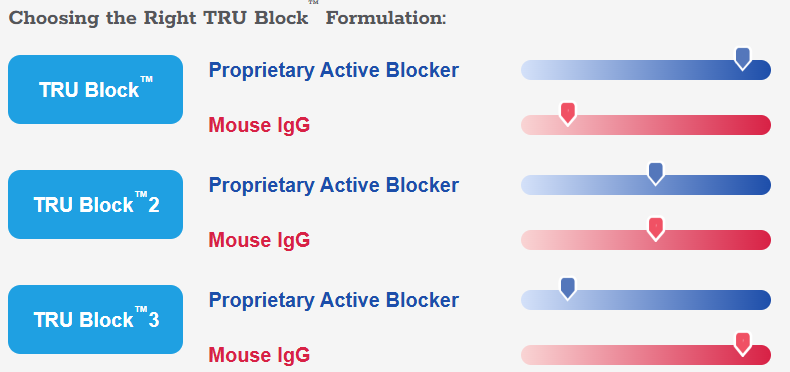
Each formulation is tailored to varying levels of interference and effectively blocks HA, HAMA, and RF.Learn more about our blockers.
Benefits
- Proven HAAA and RF blocking
- Minimal impact on assay kinetics
- Customizable and bulk available
Understanding Universal (active and passive) Blockers: Targeted Protection Against HAMA and RF
Active blockers prevent immunoassay interference by specifically binding and neutralizing interfering antibodies like HAMA and RF, whereas passive blockers, such as mouse IgG, rely on competitive binding and often require higher concentrations to be effective.
How do active blockers like TRU Block™ provide broader, more efficient protection against antibody interference than traditional options like Mouse IgG?
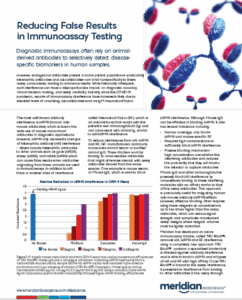
Read this whitepaper to learn how they improve assay accuracy by directly neutralizing HAMA, RF, and other interfering antibodies.
Has COVID impacted immunoassay interference by increasing the risk of false results from elevated autoantibodies like RF?

Read this blog to learn how elevated autoantibodies like RF could be driving more false results in diagnostics.
K-BLOCK™
Recombinant immunoassay blockers offer key advantages over traditional animal-derived options. Because they are precisely engineered, they deliver high batch-to-batch consistency, more predictable performance, and greater confidence in assay reproducibility—especially important in regulated and high-throughput environments.
K-BLOCK™ is Meridian’s latest proprietary blocking solution, designed to actively neutralize a broad spectrum of interfering substances—including HAMA, RF, and other HAAAs. Produced through in vitro recombinant technology, K-BLOCK™ is entirely animal-free, offering a consistent and scalable solution for interference control.
Learn more about our blockers.
Benefits
- High batch-to-batch consistency with predictable performance
- Actively neutralizes a broad spectrum of interference including HA, HAMA, RF, and other HAAAs
- 100% Animal-free
Why choose a recombinant blocker over a traditional animal-derived solution?
Recombinant immunoassay blockers offer key advantages over traditional animal-derived solutions. Produced using precise recombinant technology, they provide enhanced specificity, improved batch consistency, and eliminate the ethical and supply concerns of animal-based reagents.
Watch this webinar to learn the key advantages of recombinant blockers over traditional animal-derived solutions.Understand how these cutting-edge solutions improve assay accuracy by directly neutralizing HAMA, RF, and other interfering antibodies—without the variability of animal-based blockers.

FAQS
What is the difference between passive and active blockers?
Passive blockers such as mouse serum or Mouse IgG work by binding non-specifically to weakly cross-reactive antibodies, helping to reduce false results. Active blockers like K-BLOCK™ provide more targeted protection, especially against human anti-mouse antibodies (HAMA) and rheumatoid factor (RF). Universal blockers provide both passive and active blocking.
How to determine if I should use TRU Block™ or Mouse IgG?
While mouse IgG can reduce interference from antibodies like HAMA, it typically requires higher concentrations to be effective—potentially affecting the assay signal. TRU Block™, on the other hand, is designed to directly and efficiently block a wider range of interfering antibodies, including both HAMA (and other HAAAs) and rheumatoid factor (RF), even at lower concentrations. For standard tests with low interference risk, mouse IgG may be sufficient. TRU Block™ is the preferred option when working with samples prone to high levels of interference or in high-stakes diagnostic tests—such as those used to detect acute conditions like heart attacks—where reliable and precise results are vital.
Which types of assays are most susceptible to antibody interference?
Assays that rely on antibody–antigen binding—such as sandwich assays, competitive immunoassays, and antibody capture formats—are particularly vulnerable to interference from heterophilic antibodies like HAMA. This is especially true when mouse monoclonal antibodies are used as both capture and detection reagents, as these can be targeted by human anti-animal antibodies present in patient samples.
How do I choose the right blocker for my assay?
Several factors influence blocker selection:
- Host species of the antibodies used
- The immunoassay configuration (e.g., sandwich or competitive)
- Type of biological sample (serum, plasma, etc.)
- Anticipated interference risks (e.g., RF, heterophilic antibodies
If you’re unsure, reach out to Meridian’s technical experts for personalized guidance based on your assay’s parameters.
What are the main types of antibody interference in immunoassays?
One of the most common causes of immunoassay interference is the presence of human anti-mouse antibodies (HAMA), which can bind to mouse-derived assay components and disrupt results.
In addition to HAMA, patients may produce heterophilic antibodies against other animal species (human anti-animal antibodies, or HAAAs) frequently used in assay development—such as goat (HAGA), sheep (HASA), or rabbit (HARA).
Rheumatoid factor (RF), particularly the IgM subtype, is another significant source of interference. It can bind non-specifically to the Fc portion of IgG antibodies, mimicking true analyte signals and potentially causing false positives or negatives.
What is rheumatoid factor (Rf)?
Rheumatoid factor (RF) is an autoantibody that targets the Fc region of IgG antibodies. The most common and clinically significant type in immunoassay interference is IgM RF, which—due to its pentameric structure—is particularly effective at crosslinking antibodies and forming immune complexes. IgM RF is frequently found in individuals with rheumatoid arthritis (present in approximately 50% of cases), but elevated levels can also appear in about 1 in 20 people without the disease, especially among the elderly.
How does rheumatoid factor (RF) cause false signals in immunoassays?
Rheumatoid factor can mimic antigen–antibody binding by bridging capture and detection antibodies, generating artificial signals in immunoassays. It often targets the Fc regions of IgG molecules and may cross-react with antibodies from both human and animal sources.
What can be done to prevent post-COVID interference in immunoassays?
After COVID-19 infection, many individuals exhibit increased levels of polyreactive antibodies, including IgM RF. These immune alterations can interfere with immunoassay performance, leading to inaccurate results. To safeguard assay reliability, it’s essential to validate using post-COVID clinical samples and incorporate high-performance active blockers—such as TRU Block™—to minimize the risk of interference across varied patient populations.