
Isothermal Amplification Techniques Gain Momentum
In the intricate realm of healthcare, where answers often hide in the tiniest of details, molecular diagnostics, especially point-of-care diagnostics, have emerged as a key
Choose a country to view content specific to your location

| Library | Average mapped reads (%) |
|---|---|
| Lyophilized reagents | 99.79 ± 0.04 |
| Liquid reagents | 99.79 ± 0.12 |
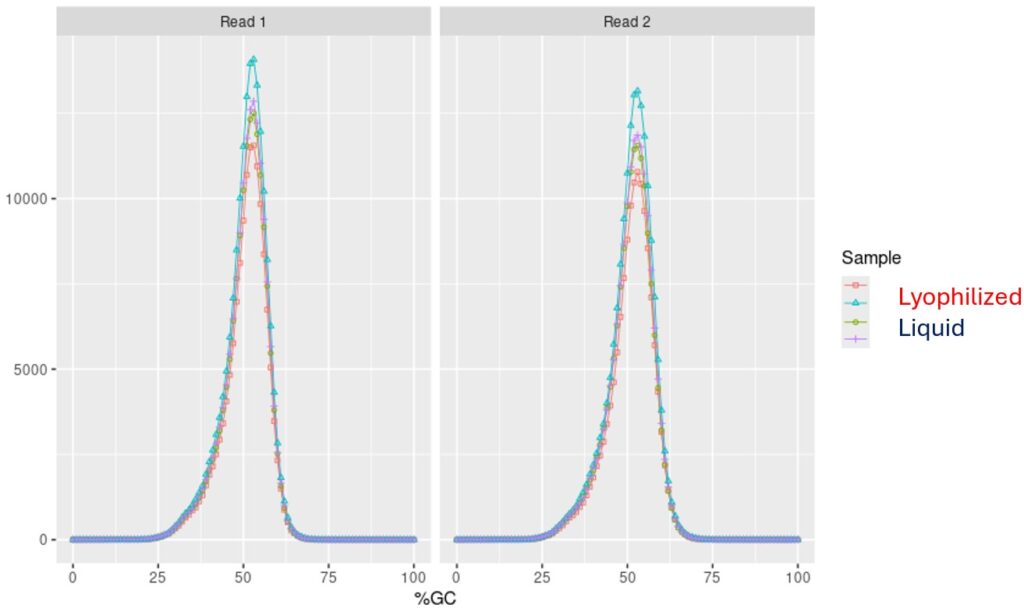
Comparison of libraries created using lyophilized and liquid formulations. The table shows mapping efficiency, while the chart displays the GC content of the libraries generated with lyophilized and liquid reagents. In both cases, lyophilized and liquid formulations showed similar results, with good mapping efficiency and comparable GC content.
Meridian’s glycerol-free NGS Library Prep Enzymes enable high-fidelity, high-efficiency library preparation, allowing sequencing kits to be shipped and stored at ambient temperature for greater accessibility. Ambient-temperature NGS assays eliminate cold-chain logistics, expanding access to genomic testing in resource-limited settings. By driving scalable, high-performance sequencing technologies, Meridian is bridging the gap, making NGS-based diagnostics more accessible, efficient, and impactful worldwide.
Next-generation sequencing (NGS) is widely used in clinical diagnostics and precision medicine, with applications spanning oncology, infectious disease, reproductive health, and genetic disorder screening. In cancer care, NGS supports companion diagnostics (CDx) for targeted therapies, minimal residual disease (MRD) monitoring, and liquid biopsy for non-invasive tumor detection. It plays a crucial role in infectious disease diagnostics, identifying pathogens, antimicrobial resistance markers, and tracking viral outbreaks. In reproductive medicine, NGS enables non-invasive prenatal testing (NIPT), carrier screening, and preimplantation genetic testing (PGT). Additionally, it is instrumental in rare disease diagnosis, pharmacogenomics, transplant medicine, and neurological disorder screening, offering personalized insights for treatment decisions. As NGS technology advances, its role in cardiovascular risk assessment, immunogenetics, and population genomics continues to expand, further integrating precision medicine into routine clinical practice.
Next-Generation Sequencing (NGS)
In the intricate realm of healthcare, where answers often hide in the tiniest of details, molecular diagnostics, especially point-of-care diagnostics, have emerged as a key
Imagine diagnostic assays that can be shipped and stored at room temperature, removing the need for freezing or refrigeration while maintaining stability and performance—even in
The article discusses the underappreciated risks posed by viruses that can lead to cancer. It highlights the significant influence of oncoviruses such as HPV, Hepatitis B, and Hepatitis C, which are linked to a range of cancers. The piece delves into the mechanisms through which these viruses operate and the global impact they have on cancer incidence, emphasizing the need for increased awareness and preventative measures in public health strategies.
Since COVID-19, changes in the immune system, specifically increased levels of autoantibodies such as rheumatoid factor (RF), have begun to impact diagnostic testing by increasing
The world of diagnostics is evolving rapidly, driven by the growing need for personalized healthcare solutions. For decades, qPCR has been the backbone of diagnostic
In recent years, point-of-care testing (POCT) and next-generation sequencing (NGS) have undergone remarkable advancements, establishing themselves as fundamental tools in modern healthcare. Their use has
References: Zalis, M., Viana Veloso, G. G., Aguiar Jr., P. N., Gimenes, N., Reis, M. X., Matsas, S., & Ferreira, C. G. (2024). Next-generation sequencing impact on cancer care: Applications, challenges, and future directions. Frontiers in Genetics, 15, 1420190. https://doi.org/10.3389/fgene.2024.1420190
Meric-Bernstam, F., Brusco, L., Daniels, M., Wathoo, C., Bailey, A. M., Strong, L., & Shaw, K. (2019). Clinical applications of next-generation sequencing in precision oncology. NPJ Precision Oncology, 3, 4. https://doi.org/10.1038/s41698-019-0073-4
To detect more alterations, consider adding companion testing to NGS. (n.d.). Targeted Oncology. Retrieved from https://www.targetedonc.com/view/to-detect-more-alterations-consider-adding-companion-testing-to-ngs
| Specimen Type |
|---|
| Application |
| Catalog |
| Sizes |
| Wet(Liquid) |
| Air-Dryable |
| Glycerol-Free |
| Lyo-Ready |
| Concentration |
| High Concentration |
| Description |
| Request Sample |