
Air-Dryable™ Direct DNA qPCR Plant Master Mix
Air-Dryable™ Direct DNA qPCR Plant is a glycerol-free mix that contain optimized excipients compatible with air and oven drying. It has been designed for the development of qPCR assays for direct detection of plant DNA from crude lysate without extraction. Can also be used wet and/or with purified nucleic acid.
Have questions about a product?
Meridian's Air-Dryable™ Direct DNA qPCR Plant
- For ultra-sensitive direct qPCR plant DNA testing using crude lysate samples.
- Simplify plant DNA testing, by removing the DNA extraction step and shortening the sample-to-result workflows.
- Designed for genotyping, transgene plant detection, GMO testing and knockout analysis.
- Can be used wet or it can be dried, for developing an ambient-temperate stable assay.
Detection down to a single copy of Rice ATPe in tomato lysate with high reaction efficiency
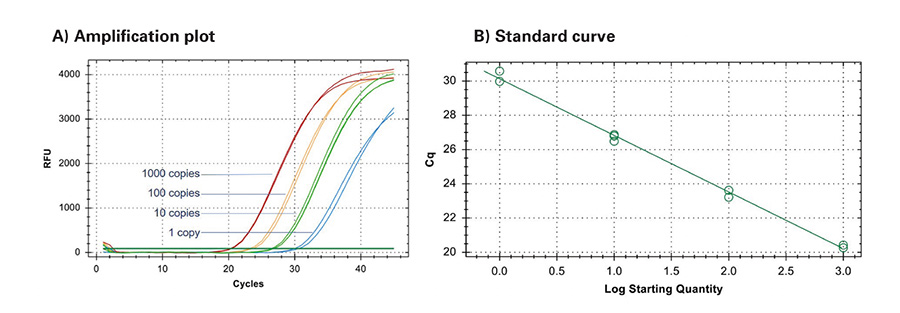
Air-Dryable™ Direct DNA qPCR Plant Mix was air dried with rice ATPe primers and probe. The dried material was reconstituted in 40% tomato leaf alkaline lysate containing 1,000 copies (brown), 100 copies (amber), 10 copies (green) and 1 copy (blue) genome equivalents per reaction of Rice gDNA.
The results illustrate the sensitivity of the Air-Dryable™ Direct DNA qPCR Plant Mix to (A) detection down to 1 copy of Rice ATPe in tomato lysate with (B) 100% reaction efficiency.
Air-Dryable Direct DNA qPCR Plant, 4x, MDX116
No need for extraction, compatible with 25% Plant lysate (SDS, NaOH). Perfect for multiplexing and fast cycling conditions for in-field qPCR testing. Used for genotyping and transgene or pathogenic detection.
Available in 5 mL (1,000 Rxns) or 50 mL (10,000 Rxns) aliquots
Meridian Life Science Division's Air-Dryable™ Plant Mix was recently named one of the Top 10 most innovative products for 2021 by SeedWorld.


Meridian has developed a new Air-Dryable™ Direct DNA qPCR Plant mix, which is inhibitor tolerant and can be used with crude extracts of plant samples. It’s also air-drying compatible for creating ambient-temperature stable assays.
Click the “Play Button” on the left to learn more.
Description
The introduction of genetically modified organisms (GMO) in the last 20 or so years and the demand for more precise and reliable techniques to detect foreign (transgenic or pathogenic) DNA in edible plants have been the driving force for the introduction of qPCR techniques in plant research. Direct amplification of crudely lysed plant DNA samples is a fast and convenient technique that avoids the need for laborious, time-consuming, and expensive nucleic acid extractions prior to qPCR. Air-Dryable™ Direct qPCR Plant is the first commercially available mix designed for developing ambient-temperature stable assays for the direct quantitation of DNA from plants. It combines the benefits of inhibitor tolerance with air-drying to create highly sensitive and cost-effective plant assays.
Specifications
| Description | Glycerol-free qPCR mix containing Taq polymerase, reaction buffer, dNTPs, MgCl2 and air-dry compatible excipients, developed to tolerate the effects of the inhibitors present in plant lysate. |
| Concentration | 4x |
| Appearance | Clear, colorless solution |
| Hot Start | Antibody mediated |
| Application | Probe-based real-time PCR, Direct PCR from plant lysates |
| Sample type | Crude or purified DNA from plant tissue |
| Presentation | 1 vial |
| Storage | -20 °C |
| Mix stability | See outer label |
| Assay stability | Up to 24 months at ambient temperature following air-drying |
| Consistency | ± 0.5 Ct variance between test and reference sample |
| DNA Contamination | None detected in PCR amplification with traces overlay with the negative control on E. coli and mouse genomic DNA specific targets. |
| DNase/RNase Contamination | No detectable degradation |
Catalogs & Brochures
FAQs: qPCR Plant Test
What types of PCR inhibitors are found in plant tissues?
Plant tissue can contain humic acids, pectin, polyphenols, complex polysaccharides, tannins and xylan
What is your recommendation to take a sample from plant for Direct qPCR?
In order to obtain best results for plant DNA testing, it is important to use a very small amount of starting materials. The recommended size is 1.2 mm in diameter single leaf punch (0.1 mg).
After drying for how long will the mix stay stable to use? Or do we need to use it immediately after drying?
It is stable for up to 2 years at ambient temperature if correctly stored in sealed pouches.
Is a pre-treatment needed for the plant material?
That will depend on the plant tissue, for soft leaf samples a direct heat lysis can be applied, a single leaf punch (leaf disc of ø1,2 mm or approximately 0.1 mg) is heated at 95 °C for 5 min in 20 µL water. For tougher tissue a SDS lysis (A single leaf punch is heated at 95 °C for 5 min in 26 µL SDS Lysis Buffer (0.1% SDS)) or alkaline lysis (A single leaf punch was heated at 95 °C for 5 minutes in 20 µL alkaline Lysis Buffer (0.2 M NaOH) and neutralised using 6 µL 2 M Tris-HCl, pH 7.5 (Total lysate volume per leaf punch = 26 µL)) may be necessary.
Is qPCR a validated GMO test?
In the European Union (EU), labelling of any food and feed product containing or consisting of genetically modified organisms (GMOs) is mandatory (Regulation No 1830; Regulation No 1829). In order to comply with existing legislation, analytical methods for GMO quantification and detection must be available. Currently, qPCR is the technique of choice for GMO determination. qPCR can also be used to determine copy number in a transgenic plant (as multiple transgenes tend to be unstable and the plants more difficult to commercialize, qPCR screening for single copies can therefore save time and resources in future generations).
Are reaction conditions the same for air-dried and liquid mixes?
Yes, the Air-Dryable™ Direct DNA qPCR Plant be used as a liquid mix or air/oven dried and stored for up to 24 months without needing to change the reaction conditions and air drying/ambient temperature storage will not affect the sensitivity of the test.
Get in Touch with a Life Science Specialist
Have questions about a product? Want to learn more about Meridian’s molecular or immunoassay reagent portfolio? We want to hear from you!
By submitting your information in this form, you agree that your personal information may be stored and processed in any country where we have facilities or service providers, and by using our “Contact Us” page you agree to the transfer of information to countries outside of your country of residence, including to the United States, which may provide for different data protection rules than in your country. The information you submit will be governed by our Privacy Statement.