
Lyo-Ready qPCR Mix, 2.6x
Meridians Lyo-Ready mixes are glycerol-free mixes, ideal for developing ambient temperature, lyophilized, multiplex qPCR molecular diagnostic tests and are suited for high-throughput, automated platforms or microfluidic qPCR platforms requiring millisecond rehydration times.
Have questions about a product?
Meridian's Lyo-Ready qPCR Mix, 2.6x
- Very fast reaction kinetics – ideal for multiplex qPCR assays and low-copy number targets
- Glycerol-free mixes are pre-formulated with a specialized blend of lyo-excipients, compatible with lyophilization into beads or cakes
- Higher concentration makes it ideal for molecular diagnostic tests on microfluidic qPCR platforms
Powerful multiplexing capacity
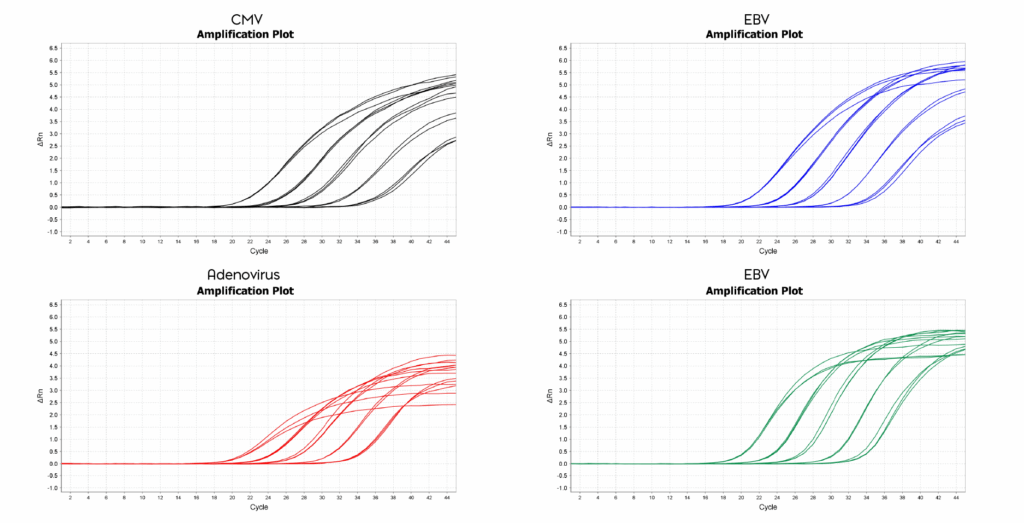
Three viral sequences, Cytomegalovirus (CMV) Adenovirus, Epstein-Barr Virus (EBV) and a DNA Extraction Control were amplified with equal efficiency from synthetic DNA templates with Lyo-Ready qPCR Mix in a quadruplex qPCR probe assay. The result illustrates that all three viruses were amplified with high efficiency and sensitivity, demonstrating the ability of Lyo-Ready qPCR Mix to detect low-copy number DNA targets simultaneously from a single sample.
Lyo-Ready qPCR Mix 2.6x, MDX023
Glycerol-free Taq polymerase, reaction buffer, dNTP, MgCl2, and lyo-excipients, ideal for developing room temperature, lyophilized, multiplex qPCR assays.
Available in 8 mL (500 Rxns) or 100 mL (12,500 Rxns) aliquots
Description
Molecular diagnostic tests are progressively moving towards lyophilized formats. There are several advantages for this, including ambient temperature shipping and storage, extended shelf-life, reduced operating steps and potential errors and increased flexibility in sample volume. In order to be compatible with drying, however, enzyme preparations must be glycerol-free and include specialized excipients that preserve the mixture as it is exposed to various conditions including freezing, vacuum, and dehydration.
Lyo-Ready qPCR Mix 2.6x is used for the development of DNA based multiplex qPCR tests, enabling highly sensitive detection of target DNA, at a slightly higher concentration than the Lyo-Ready qPCR Mix (MDX021), the Lyo-Ready qPCR Mix 2.6x Mix is for use with microfluidic qPCR, where the initial volume needs to be smaller.
Specifications
| Description | Glycerol-free master mix containing Taq polymerase, reaction buffer, dNTP, MgCl2 and lyo-excipients, for highly reproducible, accurate assay results under fast thermal cycling conditions, use with microfluidic instruments. |
| Concentration | 2.6x |
| Format | Clear, colorless solution |
| Hot Start | Antibody mediated |
| Application | Probe-based, real-time PCR, two-step RT-qPCR, one-step RT-qPCR |
| Sample type | cDNA, DNA |
| Presentation | 1 vial |
| Storage | -20 °C |
| Mix stability | See outer label |
| Assay stability | Up to 24 months at ambient temperature following lyophilization |
| Consistency | ± 0.5 Ct variance between test and reference sample |
| DNA Contamination | None detected in PCR amplification with traces overlay with the negative control on E. coli and mouse genomic DNA specific targets. |
| DNase/RNase Contamination | No detectable degradation |
Catalogs & Brochures
FAQs: Lyo-Ready qPCR Mix 2.6x
What causes low efficiency in qPCR?
Slope of standard 10-fold dilution curve indicates qPCR efficiency. The efficiency of the qPCR should be between 90–110% (−3.58 ≥ slope ≥ −3.1). If the efficiency is greater than 100%, this indicated inaccurate sample and reagent pipetting, if it is less than 100%, this indicates your samples may contain PCR inhibitors or your qPCR primer and/or probe design may not be optimal.
Are reaction conditions the same for lyophilized and liquid mixes?
Yes, reaction conditions are the same and they will produce the same Ct values, even with multiplex qPCR assays. This means that the liquid mixes can be used to create SOPs if you do not want to lyophilize and then later if lyophilization is required (for example to increase sensitivity), the SOP can be updated for lyophilization, it does not require completely new SOPs to be written.
What probes can be used in qPCR?
Many fluorescent qPCR primer- and probe-based chemistries have been devised and are available from different commercial vendors for molecular diagnostic tests, the two most used are:
• Hydrolysis (TaqMan) probes. The main advantages of using hydrolysis probes are high specificity, a high signal-to-noise ratio, and the ability to perform multiplex qPCR reactions. The disadvantages are that the initial cost of the probe.
• Molecular beacons. Molecular beacons are highly specific, can be used for multiplexing, and if the target sequence does not match the beacon sequence exactly, hybridization and fluorescence will not occur. Unlike hydrolysis probes, molecular beacons are displaced but not destroyed during amplification and can be used for melt curve analysis if necessary. The main disadvantage is that they are difficult to design, requiring a stable hairpin stem that is strong enough that the molecule will not spontaneously fold into non-hairpin conformations but not be too strong, or it may not properly hybridize to the target.
Can the Lyo-Ready qPCR Mix, 2.6x be used with crude samples?
The Lyo-Ready qPCR Mix, 2.6x has some inhibitor tolerance, but for amplification from crude lysates or inhibitor-rich samples we have the universal Inhibitor-Tolerant qPCR mixes (MDX013 and MDX073) and for even greater sensitivity, we have the sample specific (blood, saliva, urine, stool, and plant) qPCR and LAMP mixes.
How long are the lyophilized mixes stable for at ambient temperature?
Following lyophilization in the presence or absence of primers and probes, the Lyo-Ready qPCR Mix, 2.6x is stable for a minimum of 24 months at ambient temperature (17 – 23 °C). Following rehydration, the assay reproducibility, sensitivity, and robustness will be the same as for a freshly made liquid mix, making the mixes ideal for point-of-care molecular diagnostic tests and microfluidic qPCR devices.
Get in Touch with a Life Science Specialist
Have questions about a product? Want to learn more about Meridian’s molecular or immunoassay reagent portfolio? We want to hear from you!
By submitting your information in this form, you agree that your personal information may be stored and processed in any country where we have facilities or service providers, and by using our “Contact Us” page you agree to the transfer of information to countries outside of your country of residence, including to the United States, which may provide for different data protection rules than in your country. The information you submit will be governed by our Privacy Statement.