
Home » Life Science » Products » Molecular Reagents » qPCR and RT-qPCR Master Mixes » Inhibitor-Tolerant qPCR/RT-qPCR Master Mixes
Inhibitor-Tolerant qPCR/RT-qPCR Master Mixes
Have questions about a product?
Meridian's Inhibitor-Tolerant qPCR/RT-qPCR Master Mixes
- Ready-to-use qPCR master mixes engineered for amplification from crude samples without the need for complex or time-consuming extraction
- 4x concentration master mix allows for greater sample volume; simply add primers, probes and clinical samples
- Ideal for developing quantitative PCR assays where sample is limited
Inhibitor-Tolerant qPCR Mix Reaction Efficiencies
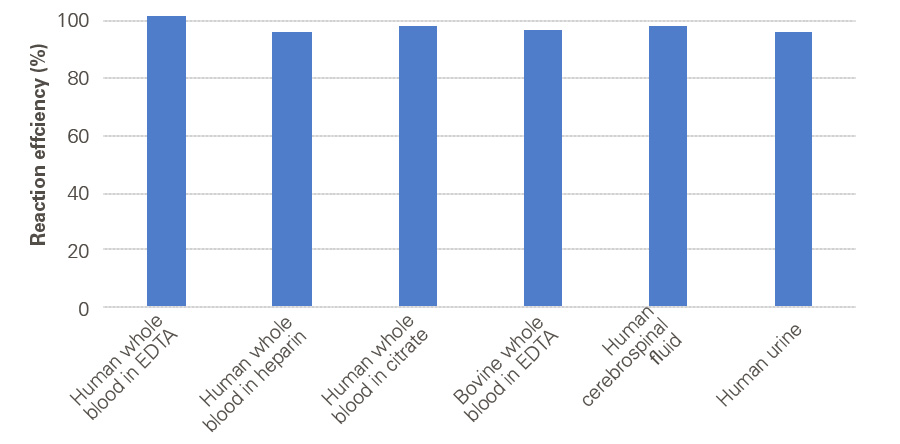
Reaction efficiencies were determined from reactions containing a variety of known PCR inhibitors ranging from whole blood to biofluids (20% in reaction). The results demonstrate that the reaction efficiency of the Inhibitor-Tolerant qPCR Buffer (used in MDX013) remained within 90-110% in the presence of a wide range of common PCR inhibitors.
Inhibitor-Tolerant qPCR Mix, MDX013
Universal inhibitor tolerant qPCR master mix, for direct amplification from crude lysates or inhibitor-rich samples such as urine, cerebral spinal fluid (CSF), blood, sputum, saliva and stool.
Documents & Resources
Inhibitor-Tolerant RT-qPCR Mix, 4x, MDX016
Universal, high concentration, inhibitor tolerant RT-qPCR master mix, for direct amplification from crude lysates or inhibitor-rich samples such as urine, cerebral spinal fluid (CSF), blood, sputum, saliva and stool.
Documents & Resources
Inhibitor-Tolerant qPCR Mix, 5x, MDX073
Combination of the latest advances in buffer chemistry and PCR enhancers and stabilizers, together with high quality enzymes, dNTPs and MgCl2, for use in the presence of inhibitors.
Documents & Resources
Inhibitor-Tolerant RT-qPCR Lo-ROX Mix, 4x, MDX105
Combination of the latest advances in buffer chemistry and PCR enhancers and stabilizers, together with high quality enzymes, dNTPs and MgCl2, for use in the presence of inhibitors.
Documents & Resources
Description
Meridian’s universal Inhibitor-Tolerant qPCR/RT-qPCR formulations are ready-to-use quantitative PCR supermixes, containing all components except primers, probes, and templates for direct qPCR and RT-qPCR. They are designed for developing qPCR multiplex assays that require minimal sample processing and fast turn-around times (TAT). Because the mixes are highly resistant to various qPCR inhibitors, they can be used with crude lysates or inhibitor-rich samples to directly detect pathogens, including viruses and bacteria, in various biological specimens and to analyze gene expression in cells.
Inhibitor-Tolerant qPCR Mix is available as a standard 2x or 5x quantitative PCR master mix; this flexibility allows assay developers more room for sample, increasing the sensitivity for low copy number samples. All steps, from pre-treatment (if required) to qPCR, to be performed in a single tube, greatly reducing hands-on time and the risk of contamination.
Inhibitor-Tolerant RT-qPCR Mix is a 4x quantitative PCR master mix, with and without low concentrations of ROX (passive reference dye), again allowing assay developers more room for sample, increasing the sensitivity for low copy number samples. Inhibitor-Tolerant RT-qPCR Mix has been designed for highly reproducible, accurate RNA and DNA target amplification under fast thermal cycling conditions, delivering excellent results in qPCR multiplex assays, even in the presence of difficult qPCR inhibitors found in blood, urine, and stool.
Specifications
| Description | A combination of the latest advances in buffer chemistry and PCR enhancers and stabilizers, together with high quality enzymes, dNTPs and MgCl2. Designed to be used in PCR reactions for highly reproducible, accurate assay results in the presence of inhibitors, such as human and animal blood. |
| Concentration | 2x, 4x and 5 x |
| Appearance | Clear, colorless solution |
| Hot Start | Antibody mediated |
| Application | Probe-based, real-time PCR, two-step RT-qPCR, one-step RT-qPCR |
| Sample type | cDNA, crude or purified RNA and/or DNA |
| Presentation | 1 vial |
| Storage | -20 °C |
| Mix stability | See outer label |
| Consistency | ±0.5/1 Ct variance between test and reference sample |
| DNA Contamination | None detected in PCR amplification with traces overlay with the negative control on E. coli and mouse genomic DNA specific targets. |
| DNase/RNase Contamination | No detectable degradation |
Catalogs & Brochures
FAQs: Inhibitor-Tolerant Mixes
What sample types can be used with the Inhibitor-Tolerant qPCR Mixes?
We have tested whole human and bovine blood, saliva, sputum, urine, cerebrospinal fluid (CSF), cow milk, stool sample, and plant lysate; other types of samples can be used but we would recommend testing different concentrations to determine the concentrations that can be tolerated. We also recommend you try out our specimen-specific qPCR/RT-qPCR master mixes specially designed for each specimen type, such as blood, saliva/sputum, urine, stool, or plant.
Do I need to add additional magnesium to the reaction?
The Inhibitor-Tolerant RT-qPCR mixes have been optimized for magnesium, dNTPs, stabilizers, and enhancers, resulting in highly reproducible, accurate RNA and DNA target amplification under fast thermal cycling conditions, delivering excellent results in qPCR multiplex assays, even in the presence of difficult PCR inhibitors. So we do not recommend adding any additional material, only the primers, probe(s), and sample.
What are the recommended reaction conditions for qPCR multiplex assays?
When multiplexing, standard conditions can be used, however, if necessary, the reverse transcription reaction time can be extended up to 20 minutes and/or the temperature can be increased up to 55° C and the annealing/extension time can be extended up to 60 seconds and/or the temperature can be increased up to 65° C, but this will need to be tested during optimization.
Do you use a mutant polymerase to overcome inhibitors?
We use our own proprietary Taq polymerase and a highly optimized buffer system to overcome inhibition.
Can these mixes be dried down for room temperature storage?
These mixes contain glycerol and so cannot be dried down; see our specimen-specific range of inhibitor-tolerant quantitative PCR mixes for lyophilized or air-dried.
Where do I begin with optimization of crude samples or crude extracts?
We would recommend using a range of crude sample concentrations or extract volumes to ascertain at what point unacceptable PCR inhibition starts to take place. This will vary as some sample types, such as blood and stool specimens typically contain more inhibitors for qPCR/RT-qPCR reactions.
Get In Touch With A Specialist
Have questions about a product? Want to learn more about Meridian’s molecular or immunoassay reagent portfolio? We want to hear from you!
By submitting your information in this form, you agree that your personal information may be stored and processed in any country where we have facilities or service providers, and by using our “Contact Us” page you agree to the transfer of information to countries outside of your country of residence, including to the United States, which may provide for different data protection rules than in your country. The information you submit will be governed by our Privacy Statement.